As an Amazon Associate, I earn from qualifying purchases.
A room can have beautiful furniture and still feel strangely flat at night.
Often, the problem is not the room itself. It is that one bright ceiling light is being asked to do everything.
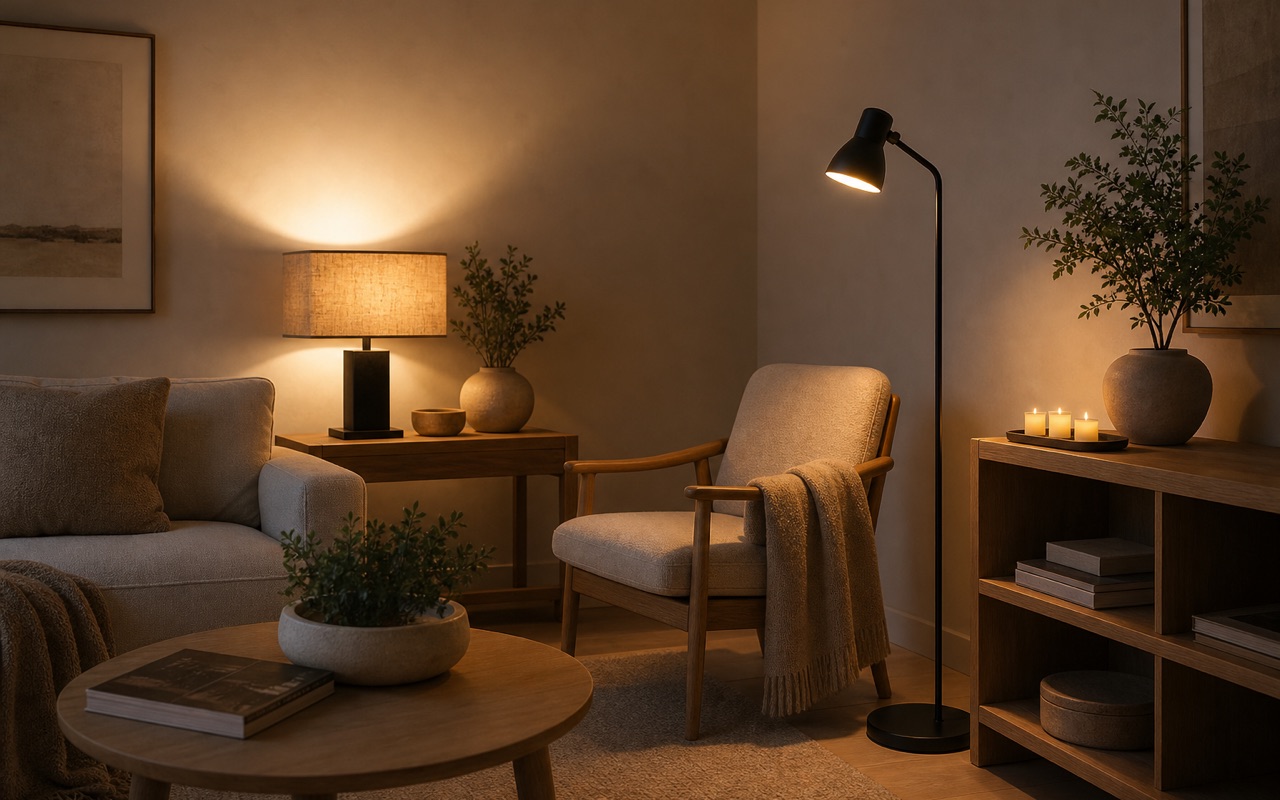
Cozy homes rarely rely on a single source of light. They use several smaller lights for different purposes: one to make the room usable, one to help you read or work, and one to create atmosphere. This is called layered lighting.
You do not need a large budget or a perfectly styled home to use it. Begin with the way you actually spend your evenings, then place light where you need it.
The Three Layers of Light
Most comfortable rooms combine three simple layers.
1. Ambient Lighting
Ambient light is the general glow that helps you move through a room. It can come from a ceiling fixture, but it can also come from a floor lamp that washes a wall with soft light.
At night, the goal is not to make every corner equally bright. A lower, warmer ambient light gives the room shape without making it feel stark.
2. Task Lighting
Task lighting supports something specific: reading, journaling, knitting, cooking or getting ready for bed.
A bedside lamp, book light or floor lamp beside a chair can provide focused light without illuminating the entire room. This is the layer that makes a cozy room practical rather than merely decorative.
3. Accent Lighting
Accent lighting creates small points of warmth. Think of a lamp on a shelf, a short strand of fairy lights or a few flameless candles on a sideboard.
This layer does not need to be bright. Its purpose is to soften empty areas and make the room feel more intentional.
Start With What You Do in the Room
Before buying another lamp, notice where your evenings actually happen.
Ask yourself:
- Where do I read, scroll or journal?
- Which corner feels too dark to use?
- Where does the overhead light create glare?
- Which light do I wish I could reach without getting up?
- Do I need a movable light because outlets are limited?
The answers give you a more useful lighting plan than copying a finished room from Pinterest.
If you read beside the sofa, begin with a floor lamp. If your nightstand feels harsh, begin with a small shaded lamp. If an outlet-free corner disappears after sunset, a rechargeable cordless lamp may solve the problem without adding a cable.
Place Light at Different Heights
One reason a single ceiling light feels flat is that all the light comes from above.
Try combining:
- a floor lamp near eye level when seated
- a table lamp on a dresser or side table
- a lower accent light on a shelf
Different heights create depth. They also let you turn on only the lights that suit that moment.
For a small room, two well-placed lamps may be enough. In a larger living room, three or four gentle sources can feel more balanced than one very bright fixture.
Choose Warm Light With Enough Clarity
Color temperature is measured in kelvin. Lower numbers appear warmer; higher numbers appear cooler.
For bedrooms, living rooms and evening corners, 2700K is a reliable cozy starting point. 3000K still feels warm but looks a little clearer, which can work well for reading or mixed-use spaces.
Brightness matters too. A warm bulb can still feel uncomfortable if it is far brighter than the room needs. Dimmable bulbs and lamps give you more control as daylight fades.
Soften the Bulb
An exposed bulb can create glare even when its color is warm. Linen, paper, frosted glass and opal shades diffuse the light so it reaches the room more gently.
This is especially useful beside a bed or chair, where the bulb may sit close to eye level.
If a lamp looks beautiful when it is switched off but feels uncomfortable when it is on, the shade, bulb brightness or placement may be the real issue.
A Simple Layering Plan for Each Room
Bedroom
Use a warm bedside lamp as the task light, then add one low accent light across the room. This keeps the room from feeling split into one bright side and one dark side.
See Cozy Bedroom Lighting Ideas Without the Overhead Light for a room-by-room setup.
Living Room
Place a floor lamp beside the seat you use most. Add a table lamp on the opposite side of the room and a subtle accent light on a shelf or console.
Reading Corner
Begin with a lamp that directs useful light toward the page. Then add a softer light behind or beside the chair so the contrast with the rest of the room is not too strong.
The same principle applies here: begin with useful reading light, then add comfort and storage only where the corner genuinely needs them.
What to Avoid
Layering does not mean filling every surface with a lamp.
Avoid:
- several lights with noticeably different color temperatures
- bright bulbs at direct eye level
- decorative lights that make reading difficult
- too many cables across walking paths
- lighting every corner equally
Leave some shadows. A cozy room needs enough contrast to feel restful.
Build the Room One Layer at a Time
Turn off the overhead light and switch on the lamp you already use most. Notice what is missing.
If you cannot comfortably read, add task lighting. If the opposite side of the room disappears, add a small ambient or accent light. Stop when the room supports your evening without feeling overlit.
For specific lamps and renter-friendly options, continue with 9 Cozy Lighting Ideas That Make Your Home Feel Softer at Night . The goal is not more lighting. It is better-placed lighting that makes your home easier to live in after dark.
Sources used for this article
- Lighting Principles and Terms — U.S. Department of Energy
- Lighting Design — U.S. Department of Energy