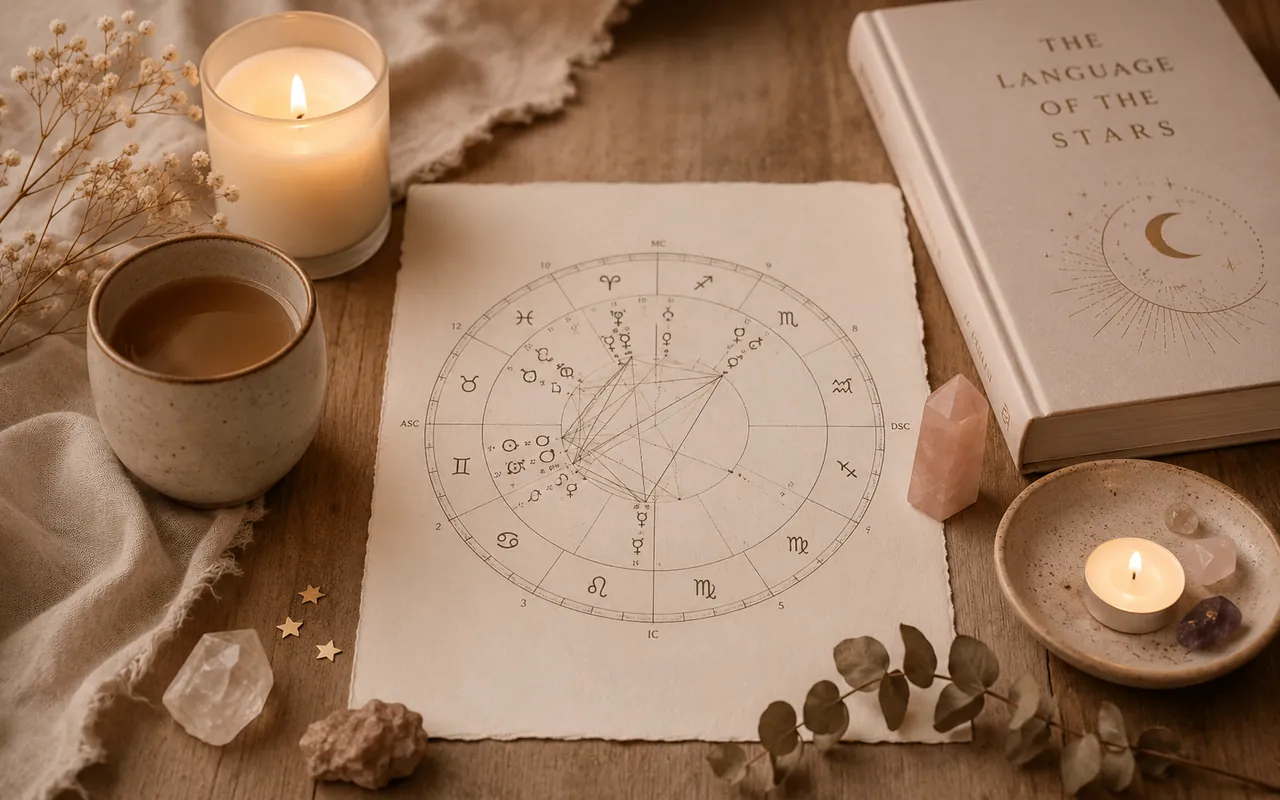
Looking at your birth chart for the first time can feel overwhelming.
You open an astrology chart and suddenly find yourself staring at circles, symbols, lines and unfamiliar abbreviations.
There are planets.
Houses.
Signs.
Aspects.
And before long, many beginners find themselves asking:
“Where do I even start?”
If you’ve ever felt intimidated by astrology, you are not alone.
The good news is that you do not need to understand everything at once.
In fact, the biggest mistake many beginners make is trying to learn the entire birth chart immediately.
Astrology becomes much easier when you begin with the right foundations.
This guide will show you exactly where to start.
What Is a Birth Chart?
A birth chart (also called a natal chart) is a map of the sky at the exact moment you were born.
It is calculated using:
- Your birth date
- Your birth time
- Your birth location
Your chart shows the positions of the planets and how they relate to one another.
Rather than predicting who you must become, a birth chart offers a symbolic language for understanding yourself more deeply.
Think of it as a map.
Not a verdict.
Astrology Guide
New to astrology?
Explore our beginner-friendly guide and discover the three placements that often make astrology finally start to make sense.
Step 1: Start With Your Big Three
The easiest way to begin reading your birth chart is by focusing on your Big Three.
These are:
- Your Sun sign
- Your Moon sign
- Your Rising sign
Many people find that understanding these three placements alone already explains why they have never fully related to their zodiac sign.
Your Sun Sign
Your Sun sign represents your core identity and personal growth.
It reflects qualities you are gradually learning to embody throughout your life.
Ask yourself:
Who am I becoming?
Your Moon Sign
Your Moon sign describes your emotional world.
It reflects:
- Emotional needs
- Instinctive reactions
- Comfort and safety
- Vulnerability
Ask yourself:
What do I need emotionally?
Your Rising Sign
Your Rising sign describes how you move through the world.
It influences:
- First impressions
- Outward behaviour
- Social style
- Personal approach to life
Ask yourself:
How do other people experience me?
Together, these three placements provide an excellent foundation.
Related Reading
- Sun, Moon and Rising Sign Explained
- What Does Your Moon Sign Mean?
- What Is a Rising Sign and Why Is It So Important?
Step 2: Learn The Planets
After understanding your Big Three, begin exploring the planets.
In astrology, each planet symbolises a different psychological function.
| Planet | Represents |
|---|---|
| Sun | Identity and life purpose |
| Moon | Emotions and inner needs |
| Mercury | Communication and thinking |
| Venus | Love, relationships and values |
| Mars | Motivation and action |
| Jupiter | Growth and expansion |
| Saturn | Responsibility and lessons |
| Uranus | Change and individuality |
| Neptune | Dreams and spirituality |
| Pluto | Transformation and deep change |
You do not need to memorise everything immediately.
Simply become familiar with the themes.
Step 3: Understand The Houses
The birth chart is divided into twelve sections called houses.
Each house represents an area of life.
For example:
- 1st House → Identity and self-expression
- 4th House → Home and family
- 7th House → Relationships
- 10th House → Career and public life
The houses answer an important question:
Where in life is this energy expressed?
For example:
Venus in Libra describes how you love.
Venus in the 10th House describes where those themes may become especially visible.
Ready To Go Deeper?
The Soft Moon Studio Astrology Guide introduces the three placements that most beginners should understand first — without the overwhelm.
Step 4: Look At The Aspects
Once you feel comfortable with signs, planets and houses, you can begin exploring aspects.
Aspects describe the relationships between planets.
They reveal how different parts of your personality interact.
For example:
- A harmonious aspect may indicate natural ease.
- A challenging aspect may describe growth, tension or inner conflict.
The lines you see inside the birth chart wheel represent these planetary conversations.
You do not need to interpret every aspect immediately.
Astrology is a lifelong language.
Allow yourself to learn gradually.
Step 5: Focus On Recognition, Not Perfection
Many beginners worry about reading their chart correctly.
But astrology is not an exam.
You do not need to understand every symbol or placement perfectly.
Instead, ask:
- What feels familiar?
- What feels true?
- What surprises me?
- What invites further reflection?
Astrology is most meaningful when it encourages self-awareness rather than certainty.
Keep what resonates.
Leave what does not.
The Biggest Mistake Beginners Make
The biggest mistake is trying to learn everything at once.
Your birth chart contains enormous depth.
Trying to interpret every placement immediately often leads to confusion and overwhelm.
Instead:
Start with:
- Sun sign.
- Moon sign.
- Rising sign.
Then gradually explore:
- Planets.
- Houses.
- Aspects.
This simple approach makes astrology far more accessible.
Why Your Zodiac Sign May Not Feel Accurate
Many people begin learning astrology because their zodiac sign never fully resonated.
This is completely normal.
Your Sun sign is only one part of your birth chart.
Your Moon sign and Rising sign often reveal equally important aspects of who you are.
This is why astrology frequently feels much more accurate once you move beyond Sun sign descriptions alone.
The Missing Piece
Most people know their zodiac sign.
Far fewer understand their Big Three.
Discover why your Sun sign was never meant to explain all of you.
Final Thoughts: Start Small
You do not need to become an expert overnight.
Astrology unfolds over time.
Begin with your Big Three.
Stay curious.
Allow your chart to reveal itself gradually.
Your birth chart is not a puzzle to solve.
It is a conversation you can return to throughout your life.
And every time you return, you may discover something new.
Continue Exploring
- Why Don’t I Feel Like My Sun Sign?
- Sun, Moon and Rising Sign Explained
- Zodiac Sign vs Birth Chart: What’s the Difference?
- Why Your Birth Time Matters in Astrology
Start Here
If you’re just beginning your astrology journey, our astrology guide offers a gentle introduction to the three placements that matter most.
Ready to explore the deeper story behind your chart?