Have you ever read your horoscope and thought: “This doesn’t sound like me at all?”
You are not alone.
For many people, astrology begins and ends with a zodiac sign. You discover that you are a Scorpio, Gemini or Leo and expect that description to explain your entire personality.
But astrology was never designed to work that way.
Your zodiac sign — more accurately, your Sun sign — is only one piece of a much larger picture.
If astrology has ever felt confusing, inaccurate or incomplete, understanding your Sun, Moon and Rising sign can completely change the way you see yourself.
Together, these three placements are often called the Big Three.
And for many people, they are the missing piece.
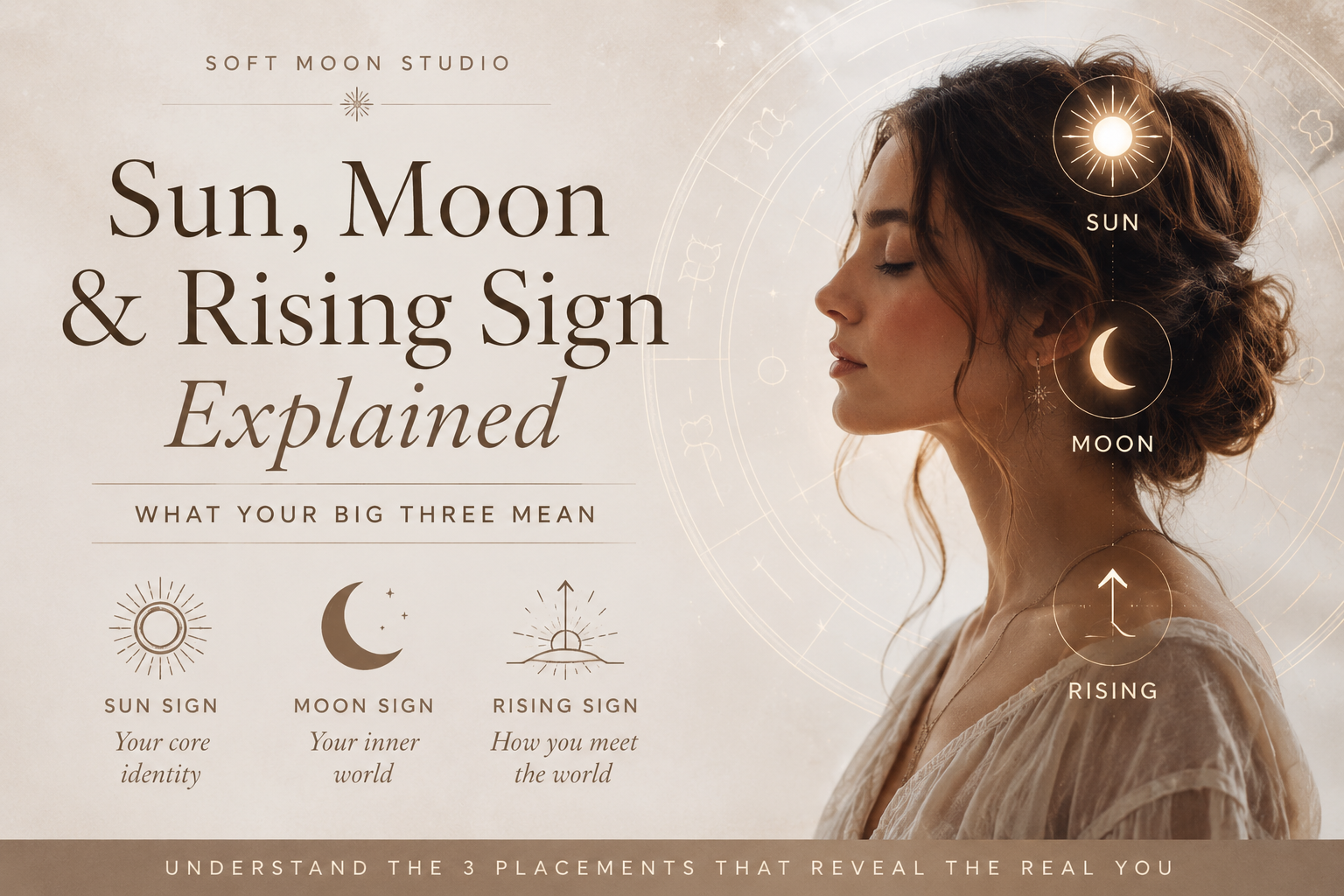
What Are the Big Three in Astrology?
The Big Three refer to:
- Your Sun sign
- Your Moon sign
- Your Rising sign (also called the Ascendant)
Each placement describes a different layer of your personality.
Think of them as three different perspectives on who you are.
| Placement | Represents |
|---|---|
| Sun Sign | Your core identity and personal growth |
| Moon Sign | Your emotional world and inner needs |
| Rising Sign | How you approach life and how others perceive you |
Together, they create a much more complete portrait than your Sun sign alone.
Why Your Zodiac Sign Doesn’t Explain Everything
Most people only know their Sun sign.
This is why astrology sometimes feels generic or inaccurate.
You may be a Cancer who prefers logic over emotion.
A Leo who dislikes attention.
Or a Gemini who would rather stay home than attend a crowded party.
These apparent contradictions do not mean astrology is wrong.
They simply suggest that other parts of your birth chart are influencing your experience.
Your Moon sign, Rising sign, planetary placements and houses all add depth and nuance.
Real people are layered.
Astrology is too.
Astrology Guide
Still feel like your zodiac sign doesn’t fully explain you?
Explore our beginner-friendly guide and discover why your Sun sign was never meant to tell the whole story.
The Sun Sign: Who You Are Becoming
Your Sun sign represents the essence of who you are.
It describes your vitality, your sense of purpose and the qualities you are gradually learning to embody throughout your life.
The Sun is often associated with:
- Identity
- Self-expression
- Creativity
- Personal growth
- Life direction
Contrary to popular belief, your Sun sign is not always the most obvious part of your personality.
Many people grow into their Sun sign over time.
For example, a Leo Sun does not necessarily crave constant attention. Their life journey may instead involve learning to express themselves more openly and confidently.
Your Sun sign is less a fixed label and more an unfolding process.
Related Reading
The Moon Sign: Your Inner World
If your Sun sign describes who you are becoming, your Moon sign describes who you already are beneath the surface.
Your Moon sign governs:
- Emotional needs
- Instinctive reactions
- Comfort and safety
- Vulnerability
- Emotional processing
It reflects the part of you that appears when you are alone, with loved ones or under stress.
Many people find that their Moon sign feels surprisingly accurate.
A person with a Gemini Moon may have an endlessly active inner dialogue.
Someone with a Pisces Moon may absorb the emotions and atmosphere around them without even realising it.
Your Moon sign offers insight into what helps you feel emotionally nourished and understood.
Ask yourself:
- What do I need when I feel overwhelmed?
- How do I naturally respond to stress?
- What makes me feel emotionally safe?
The Rising Sign: The Face You Show the World
Your Rising sign — also called your Ascendant — describes how you enter new experiences and how others initially perceive you.
It influences:
- First impressions
- Outward behaviour
- Personal style
- Social approach
- Your natural way of navigating life
Think of your Rising sign as the front door to your personality.
It is not a mask.
It is a genuine part of who you are, but it is not the whole house.
Someone with Capricorn Rising may appear calm, capable and reserved, even if they have a deeply sensitive Moon sign.
Someone with Libra Rising may naturally create harmony and connection, even if their inner world is much more direct or independent.
Your Rising sign often explains why other people describe you differently than you describe yourself.
Want to Understand Your Big Three More Deeply?
Our in-depth guide explores why your Sun sign, Moon sign and Rising sign often feel so different — and how they work together.
Sun vs Moon vs Rising: A Simple Example
Imagine someone with:
Sun in Leo Moon in Cancer Virgo Rising
Other people may initially experience this person as thoughtful, reserved and observant (Virgo Rising).
Privately, they may be deeply emotional, protective and sensitive (Cancer Moon).
At their core, they may gradually learn to express creativity, warmth and confidence more openly throughout life (Leo Sun).
No single sign could fully describe this person.
Together, however, the picture becomes much clearer.
Which Sign Feels Most Like You?
There is no correct answer.
Some people immediately recognise themselves in their Moon sign.
Others identify strongly with their Rising sign.
Many gradually grow into their Sun sign over time.
Instead of asking:
“Which sign is the real me?”
Try asking:
- Which sign feels most familiar?
- Which sign feels most private?
- Which sign feels like something I am still becoming?
Astrology is not a test.
It is a language for self-reflection.
Final Thoughts: You Are More Than One Sign
Your zodiac sign was never meant to explain every part of you.
You are more complex than a single placement.
The Sun, Moon and Rising sign offer a richer and more compassionate way to understand yourself.
And they are only the beginning.
Your birth chart contains many more layers waiting to be explored.
Continue Exploring
- What Does Your Moon Sign Mean?
- What Is a Rising Sign and Why Is It So Important?
- How to Read Your Birth Chart for Beginners
- Why Don’t I Relate to My Zodiac Sign?
Start Here
If you’re new to astrology and want a simple, beginner-friendly introduction to your Big Three, Explore the guide below.
Ready to go deeper?