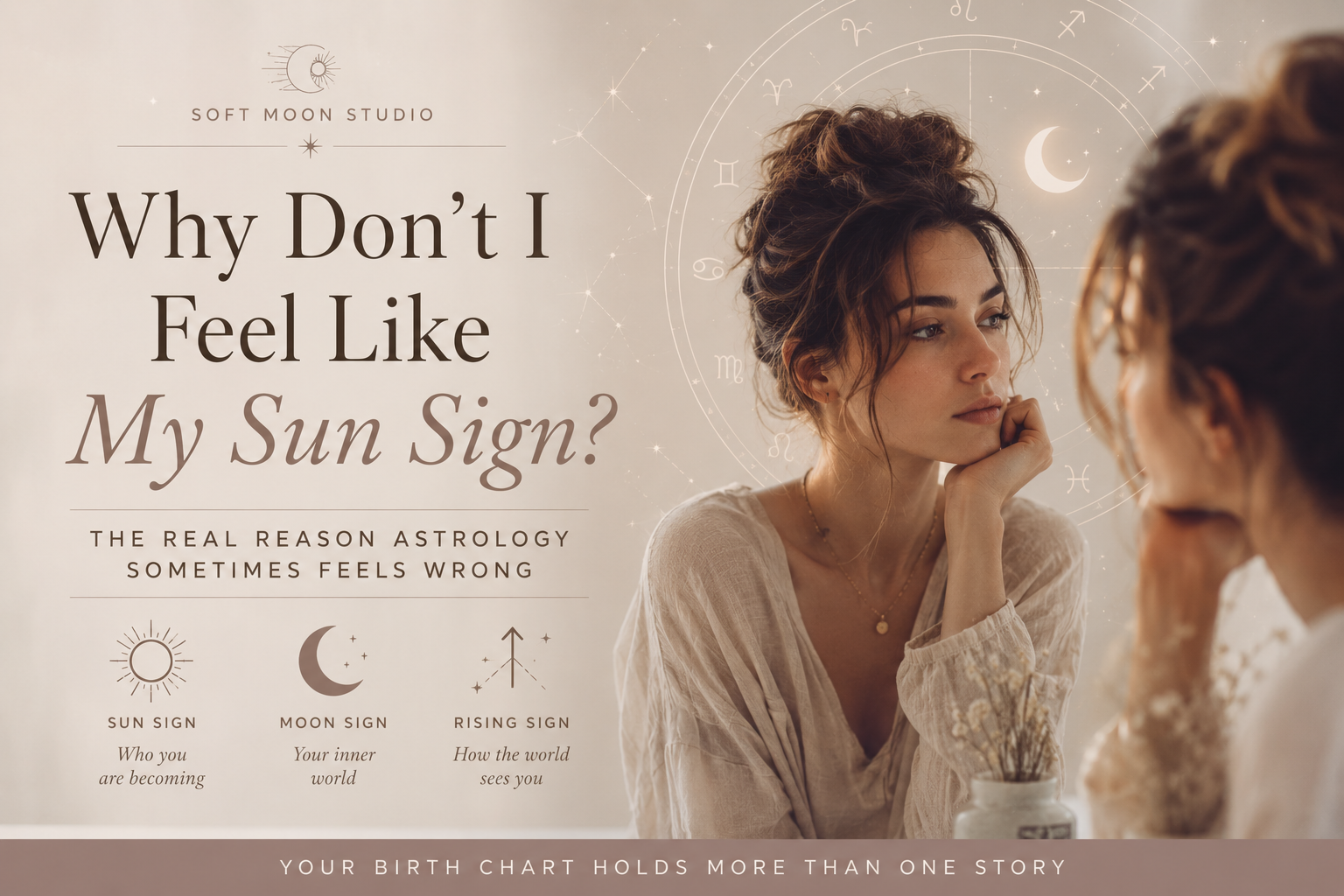
Have you ever read your zodiac sign description and thought: “This doesn’t sound like me at all”?
Perhaps you’re a Leo who hates attention.
A Cancer who rarely cries.
A Gemini who would rather spend a quiet evening alone than attend a party.
If so, you are not alone.
In fact, one of the most common questions people ask when they first begin exploring astrology is:
“Why don’t I feel like my Sun sign?”
The short answer?
Because your Sun sign was never meant to explain your entire personality.
Astrology is far more nuanced than a single zodiac sign.
And once you understand what has been missing, astrology often starts to make much more sense.
Why Doesn’t My Zodiac Sign Feel Accurate?
When most people say:
“I’m a Scorpio.”
or
“I’m a Taurus.”
they are usually referring to their Sun sign.
Your Sun sign is determined by the position of the Sun at the moment you were born.
While important, the Sun is only one placement among many in your birth chart.
Your birth chart also includes:
- Your Moon sign
- Your Rising sign (Ascendant)
- Mercury, Venus and Mars placements
- The astrological houses
- Relationships between planets (aspects)
Together, these placements create a much richer and more complex picture.
Real people are layered.
Astrology is too.
Astrology Guide
Still feel like your zodiac sign doesn’t describe you?
Explore our beginner-friendly astrology guide and discover why your Sun sign was never meant to tell the whole story.
Your Sun Sign Is Only One Part Of You
Your Sun sign represents your core identity.
It reflects qualities you are learning to embody throughout your life.
The Sun is associated with:
- Vitality
- Purpose
- Creativity
- Identity
- Personal growth
But your emotional world, instinctive reactions and social style may come from entirely different parts of your chart.
This is why many people find their Sun sign surprisingly difficult to relate to.
Your Sun sign is not necessarily the loudest part of your personality.
Sometimes it represents who you are gradually becoming.
Why Your Moon Sign May Feel More Accurate
Your Moon sign describes your inner world.
It governs:
- Emotional needs
- Instinctive responses
- Comfort and safety
- Vulnerability
- Emotional processing
Because your Moon sign operates beneath the surface, it often feels deeply personal and familiar.
A person with:
Leo Sun + Pisces Moon
may outwardly appear confident and expressive, while privately feeling highly sensitive and emotionally porous.
Someone with:
Virgo Sun + Sagittarius Moon
may appear organised and practical while internally craving freedom, exploration and spontaneity.
Many people recognise themselves more strongly in their Moon sign than in their Sun sign.
This is completely normal.
Ask yourself:
- How do I react when I’m overwhelmed?
- What do I need emotionally?
- What makes me feel safe and understood?
The answers often reveal your Moon sign more clearly than your Sun sign.
Related Reading
Your Rising Sign Influences How Others See You
Your Rising sign — also called your Ascendant — describes the energy you naturally bring into new situations.
It shapes:
- First impressions
- Outward behaviour
- Personal style
- Social approach
- How others initially experience you
This means that other people may encounter your Rising sign long before they experience your deeper personality.
For example:
Someone with:
Cancer Sun + Capricorn Rising
may be perceived as calm, composed and highly capable, even if they are privately sensitive and emotional.
A person with:
Aries Sun + Libra Rising
may appear diplomatic and gentle despite possessing a strong independent streak.
Your Rising sign often explains why people describe you differently than you describe yourself.
The Missing Piece
Most people only know one sign in their chart.
The Soft Moon Studio Astrology Guide introduces the three placements that often explain why astrology feels incomplete.
Why Astrology Sometimes Feels Generic
Popular astrology frequently reduces entire personalities to a handful of traits.
Leo becomes:
“confident.”
Pisces becomes:
“dreamy.”
Virgo becomes:
“organised.”
But human beings are far more contradictory than that.
You can:
- Love people and still need solitude.
- Be emotional and highly logical.
- Crave stability while seeking adventure.
- Appear confident while feeling deeply sensitive.
Astrology was never intended to place people into simple categories.
Your birth chart describes patterns, tendencies and potentials.
Not rigid definitions.
A Simple Example
Imagine someone with:
Sun in Gemini Moon in Pisces Capricorn Rising
Other people may experience them as serious, reserved and responsible (Capricorn Rising).
Privately, they may be deeply emotional and intuitive (Pisces Moon).
At their core, they may feel most alive when learning, sharing ideas and exploring new perspectives (Gemini Sun).
No single zodiac sign could fully describe this person.
Together, however, the picture becomes much more recognisable.
Does This Mean My Sun Sign Is Wrong?
No.
Your Sun sign is not wrong.
It was simply never designed to explain every part of who you are.
Think of your Sun sign as one voice within a larger conversation.
An important voice.
But not the only one.
The problem was never your sign.
The problem was expecting one placement to tell the entire story.
How To Understand Yourself More Deeply Through Astrology
If your zodiac sign has always felt incomplete, begin with your Big Three:
- Your Sun sign.
- Your Moon sign.
- Your Rising sign.
Together, they provide a much richer starting point for self-discovery.
From there, you can gradually explore the rest of your birth chart.
You do not need to learn everything at once.
Start small.
Stay curious.
Notice what resonates.
Final Thoughts: You Were Always More Than One Sign
If you have ever felt disconnected from your zodiac sign, there is nothing wrong with you.
You are simply more complex than a single placement.
Astrology becomes far more meaningful once you move beyond your Sun sign and begin exploring the many layers within your birth chart.
Your sign was never meant to explain all of you.
And perhaps that is exactly what makes astrology so interesting.
Continue Exploring
- Sun, Moon and Rising Sign Explained: What Your Big Three Mean
- What Does Your Moon Sign Mean?
- What Is a Rising Sign and Why Is It So Important?
- How to Read Your Birth Chart for Beginners
Start Here
Want to understand why your zodiac sign has never fully resonated?
Explore the guide below.
Ready to go deeper?